


Công nghệ gia công tẩy trắng kim loại tấm — Các phương pháp và ứng dụng tẩy trắng phổ biến


Thời gian đọc ước tính: 29 phút
The main forms of materials used in gia công kim loại tấm are plates, sections, and tubes. In order to process the sheet metal components of the required shape and other requirements, the raw materials should first be cut into blanks as required. This process is called “uncutting”, which is the first process of sheet metal processing.
There are many methods of blanking, and the main ones used in production are shearing, punching, and cutting, cutting, and several other types. The following table gives the common blanking methods included in the various blanking types and their applications.
| Phân loại | Method | Equipment | Ứng dụng |
| Cắt xén | 1.Manual shearing 2.Machine tool linear shearing 3.Short step shearing 4.Disc hobbing shears | 1.Hand shears, portable vibrating shears, manual shearing machine 2-1.Flush shear bed 2-2.Bevel shear bed 3.Vibratory shear bed 4-1.Straight round roller shears 4-2.Downward-sloping circular roller shears 4-3.Full-slope circular roller shears | 1.Used for straight and curved processing of low carbon steel, aluminum, copper and its alloys, cardboard, plywood, plastic boards and other boards with material thickness t≤4mm, with low precision and low productivity, but low cost. 2-1.High shear force, high productivity for linear profile plate processing, the material with manual shearing. 2-2.Shear force is small, suitable for medium and large straight line, large arc and bevel plate processing, shear thickness up to 40mm, the material with manual shearing. 3.Suitable for complex curves, piercing, notching processing, but also can cut titanium alloy, the material with manual shearing. 4-1.Suitable for complex curves, perforation, notching processing, but also shear titanium suitable for cutting strips of material, straight, circular arc, low precision, burr cut, suitable for small pieces of small batch production, material with manual shear, shear thickness up to 30mm 4-2.Shear straight line, arc (R smaller), the rest of the same straight circle shear, shear thickness up to 30mm 4-3.Complex curve, the rest of the same straight circle shear, shear thickness up to 20mm, accuracy ± 1mm |
| Punching and Cutting | 1.Punching and cutting | 1.Presses | 1.Commonly used for sheet, profile (t≤10mm) drop, punching, cutting, notching and other processing, high precision (drop IT10, punch IT9), high production efficiency, suitable for medium and large volume production |
| Cắt | 1.Flame cutting 2.Plasma cutting 3.Carbon arc air planer 4.EDM wire cutting 5.Laser Cutting 6.High-pressure water cutting | 1.Gas cutter, cutting torch 2.Cutting equipment, cutting torches 3.DC welding machine, air planer pliers 4.EDM wire cutting machine 5.Laser Cutting machine 6.Ultra-high pressure (≥400MPa) water cutting machine | 1.It can be used for the processing of pure iron, low carbon steel, medium carbon steel and some low alloy steel, such as plate and profile material, internal shape trimming, etc. with the accuracy of ±1mm and low cost. 2.Carbon steel, stainless steel, high-alloy steel, titanium alloy, aluminum, copper and its alloys, non-metallic materials such as the internal shape of the blanking. Narrower cut, cutting thickness up to 200mm, accuracy up to ±0. 5mm, and can be cut underwater 3.For cutting, trimming, beveling and deburring of high alloy steel, aluminum, copper and its alloys, etc. 4.For precision cutting of various conductive materials, cutting thickness up to 300mm or more, accuracy up to ± 0.01mm, can cut any shape of the plane curve and side wall slope < 30 ° of the workpiece, especially suitable for punching die manufacturing 5.Precision cutting of various materials, cutting thickness can exceed 10mm, slit 0. 15 ~ 0. 5mm, accuracy ≤ 0.1mm, but the equipment is expensive 6.Can be used for a variety of metals, non-metals (such as glass, ceramics, rocks), can be matched into the abrasive, high precision, cutting ceramics up to 10mm thick or more,but the equipment is expensive |
| Cắt | 1.Manual work 2.Machine operation | 1-1.Bow saw 1-2.Hand-held power saw, hand-held according to the machine 1-3.Electric pipe cutting machine 1-4.Pipe cutting frame 1-5.Hand-controlled grinding wheel cutting machine 2-1.Sawing Machine 2-2.Edge planing machine, planer 2-3.Sheet metal milling machine, milling machine 2-4.Lathe, Boring Machine | 1-1.Used for cutting various types, bars, pipes, plates and other metal and non-metal materials, and can saw grooves, saw hard materials, cheap tools, simple operation, but labor-intensive, low productivity 1-2.For various types, bars, tubes, plates and other unhardened metals, non-metal processing, high productivity, high noise 1-3.For ф200~1000mm metal and plastic pipe processing 1-4.Processing of medium and small diameter pipes 1-5.Various metals, non-metals (except non-ferrous metals, rubber and plastic materials) type, bar, pipe material processing 2-1.Processing of various unhardened metal profiles, bars, pipes, plastics and wood with high productivity 2-2.For cutting, trimming, beveling and other processing of plates with high precision and the same material as the saw. 2-3.Plate cutting, trimming, high precision, can cut complex curves, material with sawing machine 2-4.For cutting, beveling and trimming of bars and tubes of various materials with high processing accuracy |
It should be noted that the blanking method should be selected with respect to existing processing equipment, production capacity and the accuracy requirements of the sheet metal components to be processed, production lot, processing economy of the enterprise.
Sheet Blanking
The plate is the most common raw material used in sheet metal processing. Depending on the thickness, shape, and precision requirements of the plate used, the processing methods used are different, and the most common methods are shearing, punching, CNC turret punching, gas cutting, laser cutting, plasma cutting, etc.
Sheet shearing
Shear blanking is the use of the upper and lower knife edge for a straight blade or rotating roller blade shear movement to cut sheet blanks, it is a variety of straight, curved shape (sometimes can also get the inner shape) blank processing methods, it is suitable for all kinds of materials except hardened steel, brittle hard materials (such as cast iron, ceramics, glass, cemented carbide, etc.)
Plate shear processing is relatively simple, the following figure is a sketch of the working principle of the shear, the upper blade 8 fixed in the knife frame 1, the lower blade 7 fixed in the lower bed 4, the bed surface is installed with a ball 6, in order to facilitate the feeding of the plate material 5 mobile, after the baffle plate 9 for plate material positioning, position by the adjustment pin 10 for adjustment. The hydraulic pressure barrel 2 is used to press the plate material to prevent it from turning over during shearing. The shed plate 3 is a safety device to prevent work-related accidents. When working, the work crankshaft drives the shear slider movement, using the upper and lower shear edge of the pair of movements to cut off the material.

According to the different forms of applied shear force, shear mainly has two forms of manual shear and mechanical shear.
Manual cutting
Manual cutting is the use of manual shear equipment for shear separation of plate or coil material. It is one of the simplest original operation methods, shear equipment is simple, but the labor intensity of workers, processing efficiency is low mainly for a thin material single production and small batch production when the preparation of materials or semi-finished trimming process.
1. Tools for manual cutting
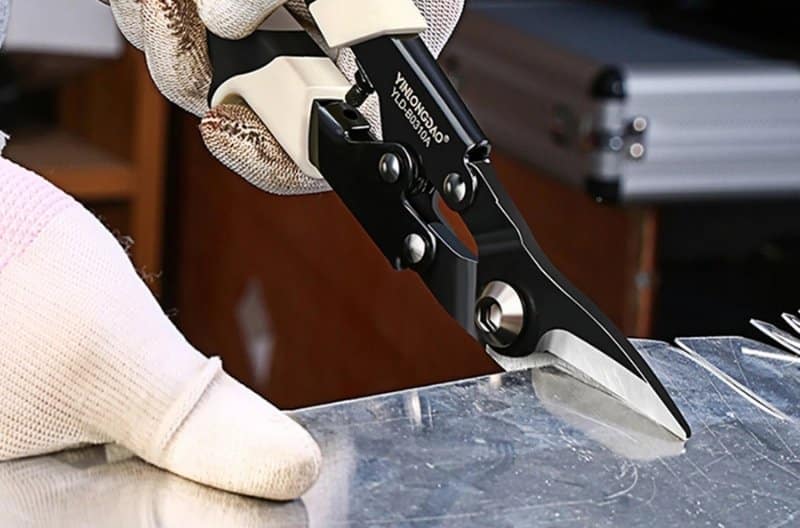
Manual cutting tools are mainly straight mouth, curved mouth shears, table shears and portable pneumatic shears, as shown below.

Straight mouth shear and curved mouth shear [see above (a), (b)] is the simplest hand shear tool, straight mouth shear because the shear edge for straight, so used to cut the straight profile of the plate material, can cut aluminum plate thickness 1.5mm, steel plate thickness 1mm; curved mouth shear because the shear edge for the curve, so used to cut the curve profile of the plate material, can cut aluminum plate thickness 2mm, steel plate thickness 0.8mm; (c) for the table shear, when using it, the The lower blade does not move, the upper blade manipulated by the lever, shear, than the hand shear effort, mainly for 1.5 ~ 2mm thick plate material cutting; (d), (e) shown wind-driven straight shear and wind-driven punching shear is a semi-mechanized hand shear tool, shear thickness up to 2.5mm.
2. Operation of hand shears
The steps and methods of operation of hand shears are as follows.
- The right hand holds the shear handle (as shown in the picture below), the shear handle should not be exposed to the palm for too long and the end should not be held in the palm of the hand.

- Left-handed material, the upper shear edge and shear line square. When cutting, shear blade opens shear blade three-quarters of the full length, shear, the shear blade is not completely together, should leave a quarter of the shear blade length, as shown in the figure below.

- When the shear edge is closed, the pressure line is cut continuously, the shear edge should be overlapped, and the gap between the two edges is maintained at 0~0.2 mm (the material is taken as a small value for thin material and a large value for thick material), as shown in the figure below.

- Cutting concave corners should first drill a hole to stop cracking or leave a certain distance at the concave corner without cutting, break the connection by hand, and then file and repair to the shear size; for angular pieces, first saw the corner root and then cut, as shown in the figure below.

3. Different parts of the hand shear operation points
For different parts of the structure, manual shear should take different shear methods, common typical hand shear operation points are mainly the following.
- Shearing of round material. When cutting round material, when the residual material is narrow, it can be cut counterclockwise, as shown in the following figure (a). When the residual material is wide,it should be cut clockwise, as shown in the following figure (b).

- Shearing of straight material. When cutting short straight material, the cut part is placed on the right side, as shown in Figure (a) below. When cutting the remaining material wider and cut length longer, the cut part is placed on the left side, as shown in the figure (b) below.

- Shearing of thick strips. When cutting thicker strips, the lower handle of the scissors should be clamped in a vise, and the upper handle should be set on a piece of pipe material, as shown in Figure 1-1.
- Shearing of the inner hole. The method of shearing the inner hole is: first open two large holes on the sheet, and then use the bending shears to shear the spiral line, gradually expanding, as shown in Figure 1-2.

Engraving and kerfing
Engraving and kerfing is another way of manual shearing. If limited by processing equipment and operating space, part structure, and other factors, the engraving and kerfing method can be used for blanking processing.
1. Burin engraving and cutting
Burin engraving and cutting is the use of burin cutting edge cutting motion on the workpiece, both for material cutting but also to remove burrs, removal of residue, etc, each burin metal layer thickness of 0.5 ~ 2 mm.

Types of burins
Commonly used burins for burin and narrow burin (see above), generally made of 45, T8, 65Mn, and other carbon tool steel and spring steel forging, and used after sharpening and quenching plus low-temperature tempering. The following table gives the heat treatment process and hardness of burins and grills of different steel grades.
| Hardening specifications | Hardening specifications | Ignition temperature/°C(Yellow and blue temperature) | Ignition temperature/°C(Yellow and blue temperature) | Ignition temperature/°C(Yellow and blue temperature) | |
| Steel number | Heating temperature/°C | Coolant (immersion depth 5~6 mm) | 240±10 | 280±10 | 320±10 |
| 45 | 830±10(Light cherry red) | Nước uống | 53±2 | 51±2 | – |
| T8 | 780±10(Cherry Red) | Nước uống | – | 56±2 | 54±2 |
| 65Mn | 820±10(Light cherry red) | Oil | – | 54±2 | 52±2 |
When processing soft materials (such as low carbon steel, electromagnetic pure iron, etc.), use the flat burin with β of 30°~50°; when processing medium hard materials (such as medium carbon steel, etc.), use the flat burin with β of 50°~60°; when processing harder materials (such as high strength steel, high carbon steel, spring steel, etc.), use the flat burin with β of 60°~70°.
Before burring, the plate material to be processed should be placed on an anvil or flat plate, depending on the situation, can be fixed under the slit of the plate material pad on soft iron and other auxiliary materials or choose C-shaped chuck or pressure plate and other fixtures. When burring thin plate material is not more than 2 mm thick, the plate material can be clamped on the vise burring, see the following figure (a). Use the flat burin along the jaws and oblique to the plate surface (about 45 °) from right to left burin cut, and make the burin cut line parallel to the jaws.
When burring off thick plate material, burin on the anvil (or flat plate). Before burring, you should first pad the soft iron material under the plate material to prevent damage to the burin cutting edge. The first burin out the dent according to the scribe line, and then hit the burin with a hand hammer to make it break. For larger size or more complex shape of the plate material, generally, drill a row of dense small holes around the contour line of the workpiece first, and then burin to burin off, see figure (b) below.

2. Grinder kerfing
Grinder kerfing is the processing of workpieces using the cutting motion of the grinder edge, mainly for thinner plates and removal of rivet heads and bolt heads from the workpiece. Commonly used kills are upper and lower kills (see Figure below), which use the same materials, sharpening and processing methods as burins. The upper grinder has a “single sharp” edge, while the lower grinder is usually made from scrap shear blades or rails.

Grinder kerfing is done with a sled hammer and is often used for cutting large thick (>3mm) sheets. Before cutting, the sheet should be placed flat on the lower grinder, the scrap part should be probed to the lower grinder, the grinder line should be corrected so that the grinder line coincides with the lower grinder, the upper grinder should be aligned with the grinder line on the sheet, the 1/3 grinder width should be probed, and the lower grinder should be placed against the lower grinder. The following diagram shows how to machine a 4 mm thick Q235A plate part.
When kerfing a straight line, keep the front of the upper grinder perpendicular to the sheet and the edge at an inclination of 10°~15° to the sheet as shown in figure (a) below.

(a)Grill position and tilt angle (b)External pupil line (c)Inner square hole (d)Inner round hole
Grinder Kerfing tools
When kerfing a curve, the upper and lower grinder blades are straight and the kerfed line can only be a straight section, so the essence of kerfing along the curve is to kerf around the curve to form an out-cut polygon. At the same time, the more frequently the sheet is rotated and the shorter the hammering, the easier it is to kerf the approximate curve, see figure (b) above.
When cutting the inner square hole, to make an accurate opening, first align the lower grinder with the lower grinder and tilt the upper grinder at an angle of 10° to 15° to contact the sheet, then gently pound the opening, and when the kerf is 2 to 3 times as long as the width of the blade, place the upper grinder flat on the starting kerf and cut through, see Figure (c) above.
When kerfing the inner hole, the first step is to select the starting point for easy kerfing, usually in a position that makes it easier to support the sheet, and make a tangent to the inner circle past the starting point to align the lower grinder, see figure (d) above, the kerf method is the same as the outer curve in Figure (b) above.
With manual shearing equipment to cut the bar and block material, generally will occur larger bending deformation, so before use, it must be calibrated.
Mechanical shearing
Mechanical shearing is the use of special shear machinery and equipment for shear separation of sheet metal, etc., is the most commonly used shear method in sheet metal processing, high production and processing efficiency.
Mechanical shearing equipment are mainly shears, vibratory shears, rolling shears, etc. According to different shearing equipment, shearing methods can be divided into flat shear, shear, vibration shear and rolling shear. Commonly used shear plate material equipment mainly shears, vibration shears, etc.
1. Shearing machine
The shearing machine is mainly used for cutting plate material, and can only cut a straight line. The shearing machine according to the different ways of transmission is divided into mechanical drive shears and hydraulic drive shears, a shear plate thickness of less than 10 mm shears more mechanical drive structure, shear plate thickness greater than 10 mm shears more hydraulic drive structure. As the thick plate shear is easy to produce bending and twisting deformation, therefore, the plate thickness of 12 mm below the plate shear processing in the production of extensive use.
- The basic method of shearing.
Shearing machine according to the upper and lower blade assembly is divided into flat blade shear and oblique blade shear, oblique blade shear than flat blade shear labor-saving, more for cutting the width the larger size and thickness of the thin plate. The following figure (a) for the upper and lower blades using the shear diagram of the oblique edge.

Beveled edge shear can greatly reduce the shear force. Beveled edge shears the lower edge is horizontal, the upper edge and the lower edge is a certain angle of inclined state, in the upper and lower edge between the shear, because the upper shear edge is inclined, shear the edge and material contact length than width of the plate material is much smaller. Therefore, this shear stroke, shear force is small, smooth work, suitable for shearing small thickness, width of the plate material.
Generally, the inclination angle φ of the upper shear edge is between 1° and 6°. When the thickness of the sheet is 3~10 mm, take φ=1°~3°, when the thickness is 12~35 mm, take φ=3°~6°. γ for the front angle, can reduce the rotation of the material when shearing; α for the rear angle, can reduce the friction between the edge and the material. γ generally take 15 ° ~ 20 °, α generally take 1.5 ° ~ 3 °.
The above figure (b) is a schematic diagram of the application of the flat blade shear flat blade shear, shear between the upper and lower parallel edges. β generally takes 0 ° ~ 15 °, this shear stroke is small, shear force, suitable for shear thickness and width of small plate material.
- Selection of shearing machine model.
The main specifications of the shear calibration are: t × B, t for the maximum allowable shear material thickness, B for the maximum allowable shear width. Selected shears can not be used to process more than the width B and the maximum allowable plate thickness t workpiece.
But in the shear of higher strength materials (such as spring steel, high alloy steel plate), you should also check the maximum allowable plate thickness ttối đa. This is because the shear design, generally according to shear medium hardness material (tensile strength of about 500MPa 25 ~ 30 steel) to consider. Therefore, if shear material tensile strength σb> 500MPa, the maximum allowable shear plate thickness ttối đa, can be calculated according to the following formula.

t —–Shearing machine calibration of the maximum allowable shear plate thickness, mm
σb —–Tensile strength of the material to be cut, Mpa
NStối đa —-Maximum allowable shear thickness, mm
Through the above formula, the conversion out of the maximum allowable shear plate thickness if less than the thickness of the material to be cut, in this shear can be used. The following table shows the technical specifications of the shearing machine models.
| Parameters | Q11-1×1000 | QY11-4×2000 | Q11-4×2500 | Q11-12×2000 | Q11Y-16×2500 |
| Thickness of sheared plate/mm | 1 | 4 | 4 | 12 | 16 |
| Width of sheared palate/mm | 1000 | 2000 | 2500 | 2000 | 2500 |
| Shearing angle | 1 ° | 2 ° | 1 ° 30 ' | 2 ° | 1°~4° |
| Number of trips(Times/minute) | 65 | 22 | 45 | 30 | 8~12 |
| Backgauge distance | 500 | 25~500 | 650 | 750 | 900 |
| Power/kW | 0.6 | 6.5 | 7.5 | 13 | 22 |
| Structure form | Conveyance under machinery | Hydraulic underdrive | Truyền động cơ khí | Truyền động cơ khí | Truyền động thủy lực |
- Selection of shear clearance.
The size of the gap between the upper and lower blades of the shearing machine, the shear section, and the surface quality of the sheared parts have a great impact. A gap that is too small, will make the fractured part of the plate material easy to squeeze bad, and increase the shear force, and sometimes damage to the machine; the gap is too large, it will make the plate material in the shear deformation, the formation of a large burr.
The reasonable clearance value of shearing is related to the material cut, the thickness of the sheet t. The value can be selected with reference to the following table.
| Material types | Clearance(t) | Material types | Clearance(t) |
| 1.Electromagnetic pure iron Soft steel (mild steel) 2.Hard steel (medium carbon or high strength steel) 3.Electrotechnical silicon 4.steel | 1.6~9 2.6~9 3.8~12 4.7~11 | 1.Stainless Steel 2.Low alloy steel 3.Hard aluminum, brass 4.Rust-proof aluminum | 1.7~13 2.6~10 3.6~10 4.5~8 |
- Shearing process method.
A shearing machine is the use of the upper and lower knife edge for the straight blade to cut the sheet blank, shear, in order to cut the sheet into a certain shape and size of the blank, the shearing machine is set up with a blocking device, blocking device by the front blocking plate, back blocking plate, side blocking plate and a special angle blocking plate composition. Before and after the baffle plate and side baffle plate can be installed in the shearing machine table or bed, and can be adjusted at any time through the adjustment mechanism for the front, back, left and right position adjustment, the angle-shaped baffle plate is generally installed in the T-shaped slot in the table, according to the shape of the plate material to be cut will be installed and fastened in different positions on the bed. In the shearing operation, first of all, should strictly comply with the shear under safety operating procedures; secondly, should ensure that the shear surface of the sheared sheet straightness and parallelism requirements, and minimize plate distortion, in order to obtain high-quality parts. To this end, according to the different shear plate material, corresponding to the selection of different shear process methods.
For general width of the plate material shear, can be scribed or positioned with the backstop, and adjust the position of the backstop with a screw. Shear with the first pressure plate will be pressed plate material, and then will be equipped with the upper shear edge of the dragging plate down, the plate material in the upper and lower shear edge staggered when cut, shear section generally without subsequent processing, to ensure the quality of shear, as shown in Figure(a) below.
For larger width of the strip shear, if the plate and then use the backstop positioning, its overhanging part will sag due to self-weight, and the ratio of the overhang and the thickness of the plate B / t, the larger the positioning error. Therefore, when the width of the strip exceeds 300~400 mm, the front baffle should be used for positioning, as shown in Figure(b)below, and the position of the front baffle can be positioned with a common measuring tool or sample board.

When shearing trapezoidal and triangular wool, the side stopper can be used with other stoppers for positioning. When installing, you can first put the sample plate on the table to align the lower edge, then adjust the side stopper and fix it. Then, adjust the backstop according to the sample plate, and use both the side stopper and the backstop for positioning when cutting, as shown in Figure(c). In addition, it is also possible to use the side baffle and other baffles together for positioning, as shown in Figure(d)~Figure(f).
In shear narrow material, due to the plate material from the pressure device farther and can not be pressed, in order to safely and smoothly shear, can be added with the same thickness of the sheared plate material and pressure plate pressure firm for shear, the pressure plate can be thicker, as shown in Figure below. The thin plate can not be added to the pad, directly through the pressure plate will be pressed firmly.

Shear narrow material with a pad
- Quality and accuracy of shear
Beveled blade shear is the most widely used in the production of shearing equipment.The use of beveled blade shear from the plate to cut the shear width of the shear parts can be determined according to the following table.
Shear width tolerance mm
| Độ dày vật liệu | ≤2 | ≤2 | >2~4 | >2~4 | >4~7 | >4~7 | >7~12 | >7~12 |
| Shearing width | A | B | A | B | A | B | A | B |
| ≤120 | ± 0,4 | ±0.8 | ±0.5 | ±1.0 | ±0.8 | ±1.5 | ±1.2 | ±2.0 |
| >120~315 | ±0.6 | ±0.8 | ±0.7 | ±1.0 | ±1.0 | ±1.5 | ±1.5 | ±2.0 |
| >315~500 | ±0.8 | ±1.2 | ±1.0 | ±1.5 | ±1.2 | ±2.0 | ±1.7 | ±2.5 |
| >500~1000 | ±1.0 | ±1.2 | ±1.2 | ±1.5 | ±1.5 | ±2.0 | ±2.0 | ±2.5 |
| >1000~2000 | ±1.2 | ±1.8 | ±1.5 | ±2.0 | ±1.7 | ±2.5 | ±2.2 | ±3.0 |
| >2000~3150 | ±1.5 | ±1.8 | ±1.7 | ±2.0 | ±2.0 | ±2.5 | ±2.5 | ±3.0 |
If the width of the strip is the size of the workpiece, the dimensional accuracy it can reach is the undercutting accuracy, which can be determined according to the following table.
Slant-edge shearing machine blanking accuracy mm
| Plate thickness/t | Width | Width | Width | Width | Width |
| Plate thickness/t | <50 | 50~100 | 100~150 | 150~220 | 220~300 |
| <1 | +0.2 -0.3 | +0.2 -0.4 | +0.3 -0.5 | +0.3 -0.6 | +0.4 -0.6 |
| 1~2 | +0.2 -0.4 | +0.3 -0.5 | +0.3 -0.6 | +0.4 -0.6 | +0.4 -0.7 |
| 2~3 | +0.3 -0.6 | +0.4 -0.6 | +0.4 -0.7 | +0.5 -0.7 | +0.5 -0.8 |
| 3~5 | +0.4 -0.7 | +0.5 -0.7 | +0.5 -0.8 | +0.6 -0.8 | +0.6 -0.9 |
The use of beveled edge shear from the plate shear straightness, verticality of the tolerance, shear burr height allowed by the following table.
Tolerance of shear straightness mm
| Độ dày vật liệu | ≤2 | ≤2 | >2~4 | >2~4 | >4~7 | >4~7 | >7~12 | >7~12 |
| Shearing width | A | B | A | B | A | B | A | B |
| ≤120 | 0.2 | 0.3 | 0.2 | 0.3 | 0.4 | 0.5 | 0.5 | 0.8 |
| >120~315 | 0.3 | 0.5 | 0.3 | 0.5 | 0.8 | 1.0 | 1.0 | 1.6 |
| >315~500 | 0.4 | 0.8 | 0.5 | 0.8 | 1.0 | 1.2 | 1.2 | 2.0 |
| >500~1000 | 0.5 | 0.9 | 0.6 | 1.0 | 1.5 | 1.8 | 1.8 | 2.5 |
| >1000~2000 | 0.6 | 1.0 | 0.8 | 1.6 | 2.0 | 2.4 | 2.4 | 3.0 |
| >2000~3150 | 0.9 | 1.6 | 1.0 | 2.0 | 2.4 | 2.8 | 3.0 | 3.6 |
2.This table applies to the shear width of the plate thickness of 25 times more and the width of 30 mm or more metal shear parts.
Tolerance of shear perpendicularity mm
| Độ dày vật liệu | ≤2 | ≤2 | >2~4 | >2~4 | >4~7 | >4~7 | >7~12 | >7~12 |
| Shearing width | A | B | A | B | A | B | A | B |
| ≤120 | 0.3 | 0.4 | 0.5 | 0.7 | 0.7 | 1.0 | 1.2 | 1.4 |
| >120~315 | 0.5 | 1.0 | 1.0 | 1.2 | 1.5 | 1.8 | 2.0 | 2.2 |
| >315~500 | 0.8 | 1.4 | 1.4 | 1.6 | 1.8 | 2.0 | 2.2 | 2.4 |
| >500~1000 | 1.2 | 1.8 | 1.8 | 2.0 | 2..2 | 2.4 | 2.6 | 3.0 |
| >1000~2000 | 2.0 | 2.6 | 3.0 | 6.0 | 6.0 | 6.5 | – | – |
Allowable shear burr height mm
| Material thickness/Accuracy grade | ≤0.3 | 0.3~0.5 | 0.5~1.0 | 1.0~1.5 | 1.5~2.5 | 2.5~4.0 | 4.0~6.0 | 6.0~8.0 | 8.0~12.0 |
| E | ≤0.03 | ≤0.04 | ≤0.05 | ≤0.06 | ≤0.08 | ≤0.10 | ≤0.12 | ≤0.14 | ≤0.16 |
| F | ≤0.05 | ≤0.06 | ≤0.08 | ≤0.12 | ≤0.16 | ≤0.20 | ≤0.25 | ≤0.30 | ≤0.35 |
| G | ≤0.07 | ≤0.08 | ≤0.12 | ≤0.18 | ≤0.32 | ≤0.35 | ≤0.40 | ≤0.60 | ≤0.70 |
2. Vibrating shearing machine
Vibration shear is also known as shear punching machine, short step shear. Vibrating shear generally according to the scribe or sample plate for shearing, commonly used in processing material thickness below 2 mm, the radius of curvature of the larger internal and external contour of the cut surface, can also be used for stamping after forming large and medium-sized parts of the cutting edge.
- Vibration shear structure and working principle.
Vibratory shear shape structure as shown in Figure (a) below.
Vibratory shear by the machine base, bed, upper, and lower cutting knife, and transmission system. The upper cutting knife fixed in the knife seat, connected to the eccentric shaft through the connecting rod, driven by an electric motor to 1500 ~ 2000 times per minute of rapid reciprocating vibration, the stroke of about 2 ~ 3 mm, the upper cutting knife and lower cutting knife blade relative tilt angle 20 °~ 30 °, and the upper and lower cutting knife itself has a large angle of inclination (about 0°~ 15°), see Figure(b) below. The shear edge is narrower, and the two knife tips are usually in contact. The overlap is about 0.2 ~ 1.0 mm.

Vibrating shear in shear material, is the use of mechanical transmission generated by the high-speed round-trip movement of the knife-edge and the lower knife edge to form a relative staggered movement of the plate material a small section of a small section of shear, this processing method called vibration shear, due to the shearing process is not continuous, so the production efficiency is very low, and poor shear quality, cutting edge rough, there are tiny jagged shape, the shape of the blank and poor processing accuracy, but because the vibration shear structure is simple, easy to operate, good adaptability to shear different shapes, sizes of parts and blanks.
- The choice of vibratory shear model
In the selection of vibratory shear, mainly based on the thickness of the plate material to choose. Vibratory shear is mainly by scribing along the plate material to cut straight lines, curves, and bore contours of the work. Sometimes they are also used to trim stamping semi-finished products. If you increase the stroke and closed height adjustment mechanism, replaced by the corresponding punching and shearing tools, but also for folding, punching groove, pressing tendons, notching forming, and other stamping processes. For large plate shear, you can generally choose the portable vibration shear. The following table shows the technical specifications of the commonly used Q34 series vibratory shears.
Technical specifications of vibratory shears
| Technical parameters | Specification Model | Specification Model | Specification Model | Specification Model |
| Technical parameters | Q34-2.5 | Q34-4 | Q34-5 | Q34-6.3 |
| Cắt xén | 2.5 | 4 | 5 | 6.3 |
| Punching | – | 1.5 | 2 | 4 |
| Folding | – | 3 | 3.5 | 3.5 |
| Groove Punching | – | – | 3 | 3 |
| Notching | – | – | 3 | 3 |
| Pressing | – | – | 3 | 3 |
| Crimping | – | – | 2.5 | 2.5 |
| Flanging | – | – | 3.5 | 3.5 |
| Throat depth/mm | 870 | 1050 | 1050 | 1260 |
| Shearing speed/(m/min) | – | – | 5 | 5 |
| Number of trips(times/min) | 1420 | 850/1200 | 1400/2800 | 2000/1000 |
| Stroke length/mm | 6.6 | 7 | 1.7/3.5 | 1.7/6 |
| Power/kW | 1 | 2.8 | 1.5 | 1.9/1.8 |
3. Rolling shear
Rolling shear, also known as the disc rolling shear (disc shear), according to the number of its hobbing knife can be divided into multi-rolling and single-rolling two types of structure. Single-rolling rolling shear only a pair of disc shear blade, and multi-rolling rolling shear installed in the spindle with a variety of combinations of pairs of disc shear blade, generally used to cut the plate material at the same time into the width of the strip or strip material, can greatly improve productivity.
Rolling shear can achieve a straight line of shear, but also along with the curve shear. The use of rolling shear can cut round or curve-shaped features, certain small batch production of large stamping parts, it can be used instead of punching die under the material or cutting edge, but the shear quality and productivity are not high. The most used in the production of a single rolling shear, its structure is shown in the figure below.

10-Oscillating shaft; 11-Manipulation handle
12~15-Bevel gear; 16-Rolling blade; 17-Drive Shaft;18-Seat
Rolling shear
- Rolling shear method
Rolling shear is used to shear the plate with a pair of disc shear blades in the opposite direction of rotation. According to the different configurations of the disc shear edge, the rolling shear method can be divided into three. As shown in Figure below, the straight configuration is suitable for cutting the plate into strips of material, or square blanks cut into round blanks; oblique straight configuration is suitable for cutting into round blanks or round bore; oblique configuration is suitable for cutting any curve profile of the blank.

- Rolling shear model selection
Selection of rolling shear, the main rated process parameters are allowed to shear the maximum thickness. With the disc shear to cut the curve profile of the blank, you also need to know the maximum diameter and minimum radius of curvature shear allowable shear. For example, Q23-4 × 1000 type rolling shear, can cut the maximum plate thickness of 4 mm, the maximum diameter of 1000 mm.
With rolling shear curve profile blank, the radius of curvature has a certain limit, the minimum radius of curvature and shear blade diameter, the thickness of the plate material. Rolling shear the minimum radius of curvature is shown in the table below.
Minimum radius of curvature for rolling shear shearing mm
| Shear blade diameter | Sheet thickness | Sheet thickness | Sheet thickness |
| Shear blade diameter | <1 | 1.5~2.5 | 3~6 |
| Shear blade diameter | Minimum radius of curvature | Minimum radius of curvature | Minimum radius of curvature |
| 75 90 100 125 | 40 50 50 50 | 45 75 75 90 | 50 85 90 90 |
The technical specification models of the commonly used rolling shears for downstream processing are shown in the table below.
Technical specifications of rolling shears
| Technical parameters | Q23-3×1500 | Q23-4×1000 |
| Shear plate thickness/mm | 0.5~3 | 1~4 |
| Shear plate strength limit σb/MPa | ≤450 | ≤450 |
| Mainframe cantilever length(throat)/mm | 1500 | 1000 |
| Tailstock cantilever length/mm | 1075 | 740 |
| Shear blade diameter/mm | 60 | 80 |
| Plate shear diameter/mm | 400~1500 | 350~1000 |
| Plate shear width/mm | 150~1200 | 150~750 |
- The quality and accuracy of rolling shear.
The minimum width deviation of the sheared strip using rolling shear is shown in the following table.
Minimum width deviation for roll shear strips mm
| Strip width | Sheet thickness | Sheet thickness | Sheet thickness |
| Strip width | About 0.5 | 0.5~1 | 1~2 |
| About 20 20~30 30~50 | -0.05 -0.08 -0.10 | -0.08 -0.10 -0.15 | -0.10 -0.15 -0.20 |

I want to shearing machine.